Your Rooftop Sells Electrons. Can Your Basement Sell Compute?
Data centers, Bitcoin miners, net metering, and the idea of an “Airbnb for AI”
TL;DR
- AI data centers have outrun the power grid. Electricity, not chips, is now the bottleneck.
- Bitcoin miners are pivoting to AI because their real asset is the grid connection, not the mining hardware.
- Rooftop solar export credits keep shrinking. Expect the same repricing if home compute ever scales.
- You can rent out a home GPU today, but power costs eat most of the payout, and it pulls from the grid instead of feeding it.
- The real household opportunity: run flexible compute on midday solar surplus and shut off at peak. Sell flexibility, not GPU hours.
Every few years someone pitches the same dream: turn the stuff sitting idle in your house into income. Rooftop solar did it with electrons. Bitcoin did it with hash rate. Now a wave of startups wants to do it with the graphics card in your gaming PC, renting it out to run AI.
It's a seductive idea, especially right now, when the big data centers can't get plugged in fast enough. So let's ask the real question: are we about to see a democratization of data centers, where regular people sell time on their own setups the way they sell solar back to the utility?
My short answer: partly, but not the way the solar analogy suggests. And the place where it actually works is more interesting than the pitch.
The problem: data centers have outrun the grid
The AI build-out has turned electricity into the bottleneck. Analysts at S&P Global expect data center power demand to more than double between 2026 and 2030, and the strain is already showing up as project delays. Some estimates put roughly half of the planned 2026 U.S. data center buildout as delayed or canceled, with multi-year waits on grid transformers cited as a main cause.
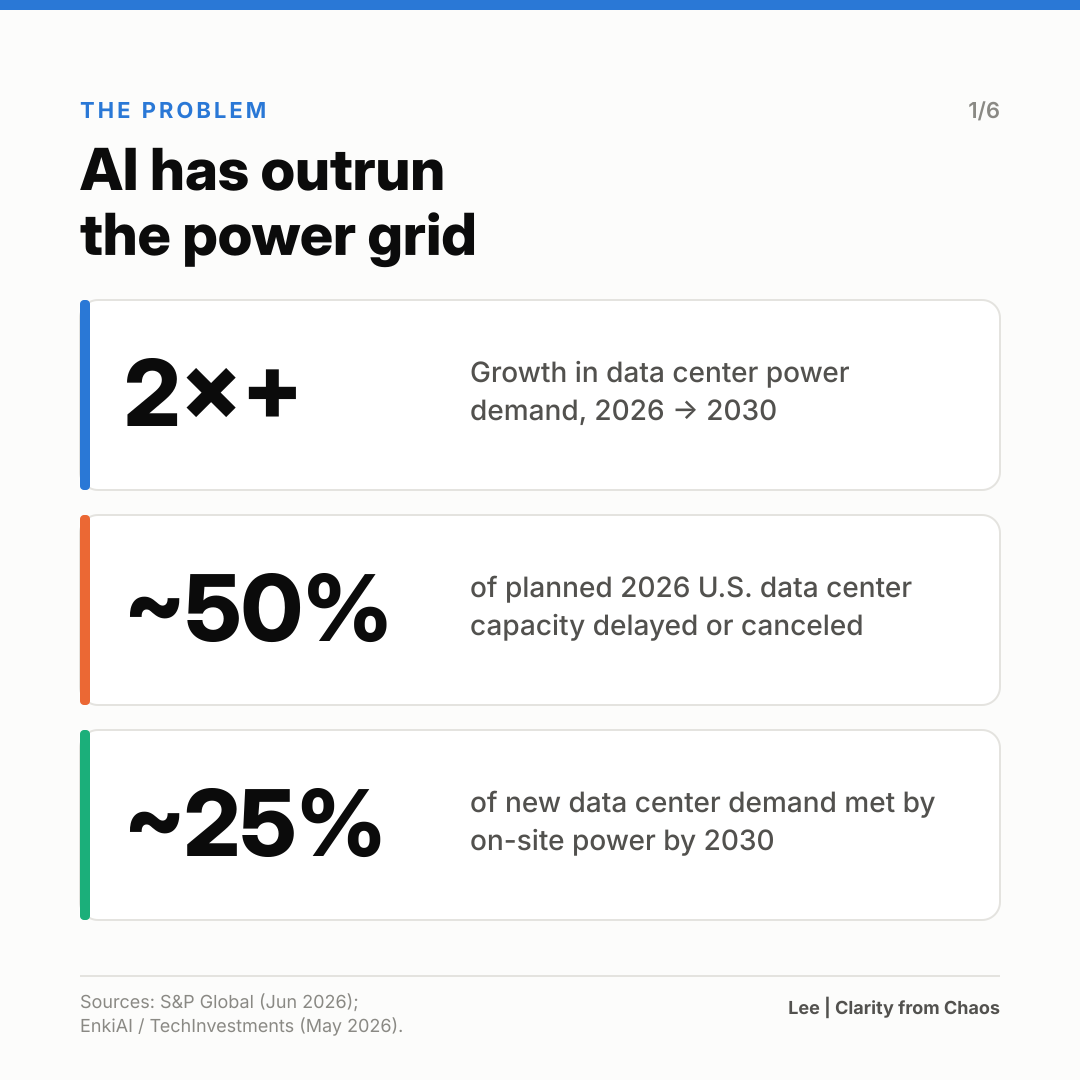
The pain isn't evenly spread. It's local. Northern Virginia, Texas, and the PJM grid region are where the crunch bites hardest, and in PJM's capacity auctions data centers have accounted for a large share of the cost increases, costs that land on everyone's bill. Winter storms this year showed how quickly big, inflexible data center loads can push a regional grid toward its limits.
So the hyperscalers are doing three things at once: building their own on-site power, chasing any site that already has a big grid connection, and learning (slowly) to be flexible.
Hold onto that second one. It's where Bitcoin comes in.
The Bitcoin precedent: it was never about the chips
Bitcoin mining is the closest thing we've had to democratized computing for profit. Anyone could plug in a machine, do the work, and get paid. No sales team, no customer contracts, no uptime guarantees.
It worked because Bitcoin's workload has properties that almost nothing else has:
- It's verifiable. The network can check your work instantly. Nobody has to trust you.
- It's permissionless. No buyer has to choose you.
- It doesn't care about latency or location. A rig in a barn is as good as one in a server farm.
- It can stop and start any time. Miners famously power down when electricity gets expensive and soak up cheap or stranded power when it isn't.
Now look at what's happened in 2026. Margins collapsed after the 2024 halving, and production costs for listed miners have climbed close to (or above) the Bitcoin price. So every major public miner has announced some kind of pivot to AI. MARA reportedly sold around a billion dollars of Bitcoin to fund the move. CoinShares projects AI could be about 70% of listed miners' revenue by year-end. One Kentucky mining campus just signed a 20-year AI lease.
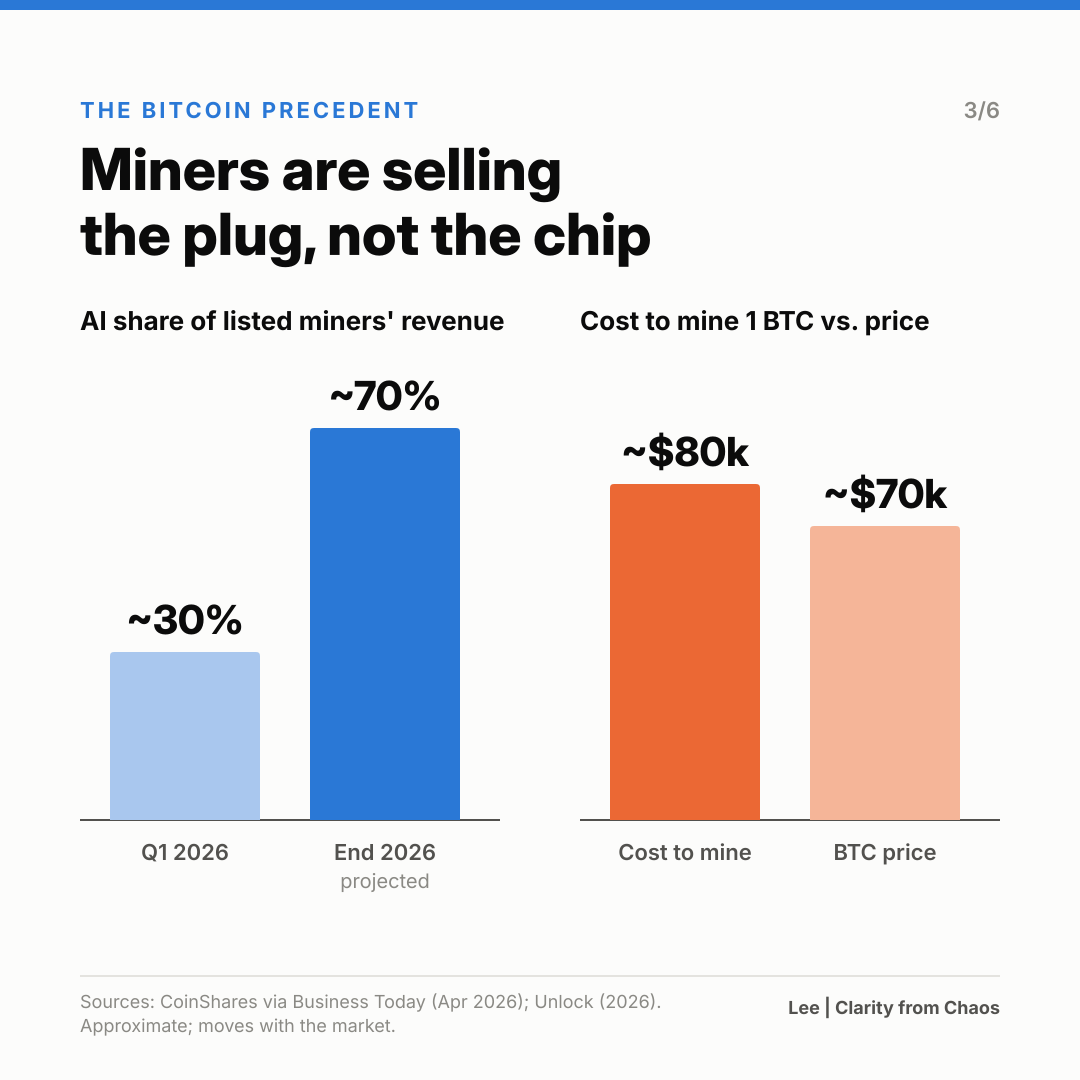
Here's the lesson that matters for the "democratization" question: the miners aren't converting their mining chips into AI chips. Bitcoin ASICs can't run AI. What the miners are actually selling is their power connection, land, and cooling, the one thing data centers can't buy fast enough.
The value was never in the computer. It was in the plug.
The solar precedent: the deal keeps getting worse
Net metering is the other half of the analogy. You put panels on the roof, you send extra power back to the grid, and the utility credits you.
That deal has been eroding for a decade. More than a third of U.S. states have restructured their net metering rules. California's NEM 3.0 cut export credits by roughly three-quarters, swapping the retail rate for an "avoided cost" rate of a few cents per kilowatt-hour. Other states are moving toward time-based or half-retail compensation, and with the federal residential solar credit gone, those export rates now carry even more of the ROI.
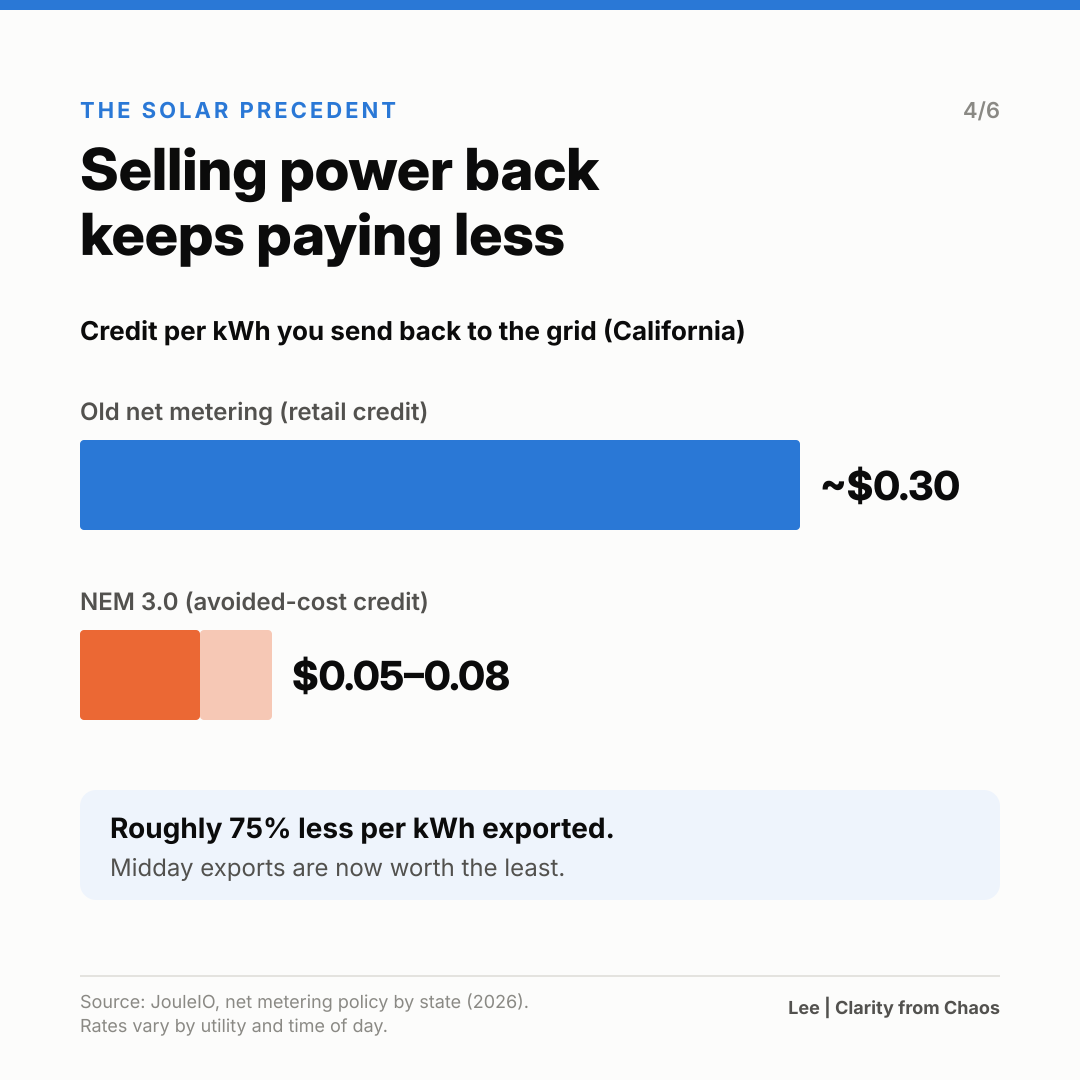
Why did it get worse? Because once enough people were selling back, utilities argued (with some merit) that full retail credit shifted grid costs onto non-solar customers. The individual seller wasn't worthless. They were just worth less than the retail price once you counted what the grid actually needed.
Remember that. It's going to apply to compute too.
So, can you sell time on your own setup?
You already can. Platforms like Vast.ai, Salad, io.net, Akash, and RunPod's community cloud let individuals list their GPUs and get paid. Salad alone coordinates tens of thousands of consumer GPUs daily. Newer startups like Far Labs and Evolving Edge are pitching an "Airbnb for AI inference," splitting small open-source models across home machines in sandboxed environments.
But the analogy to solar breaks in three places.
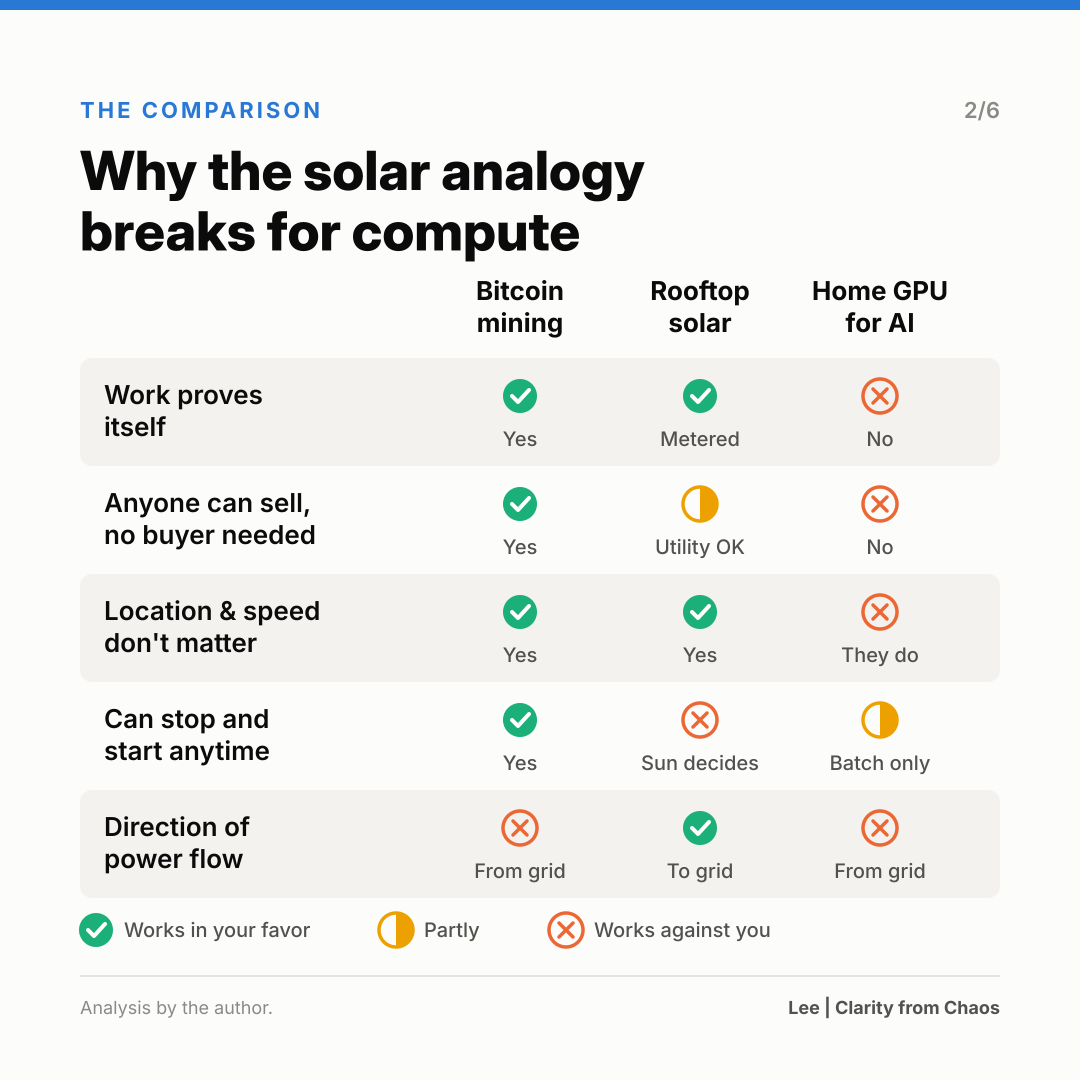
1. Electrons are interchangeable. Compute isn't. The utility doesn't care whose kilowatt-hour it gets. An AI customer cares a lot about whose GPU it gets: how much memory it has, how reliable the host is, how fast the connection is, and whether their data is safe on a stranger's machine. Frontier model training needs thousands of tightly linked chips in one room. Your 4090 in a spare bedroom can't join that party. What it can do is run smaller models, batch jobs, rendering, and fault-tolerant work that doesn't mind a node disappearing.
2. The price is already near the floor. Consumer-GPU marketplaces are cheap precisely because supply is abundant. Spot prices for consumer cards are often pennies to low dimes per hour. Meanwhile a high-end card under full load draws hundreds of watts. At normal residential electricity rates, a big chunk of that payout goes straight back to your utility. Several reviewers have made the same point: power costs can eat most of the earnings, and you're adding wear to your hardware.
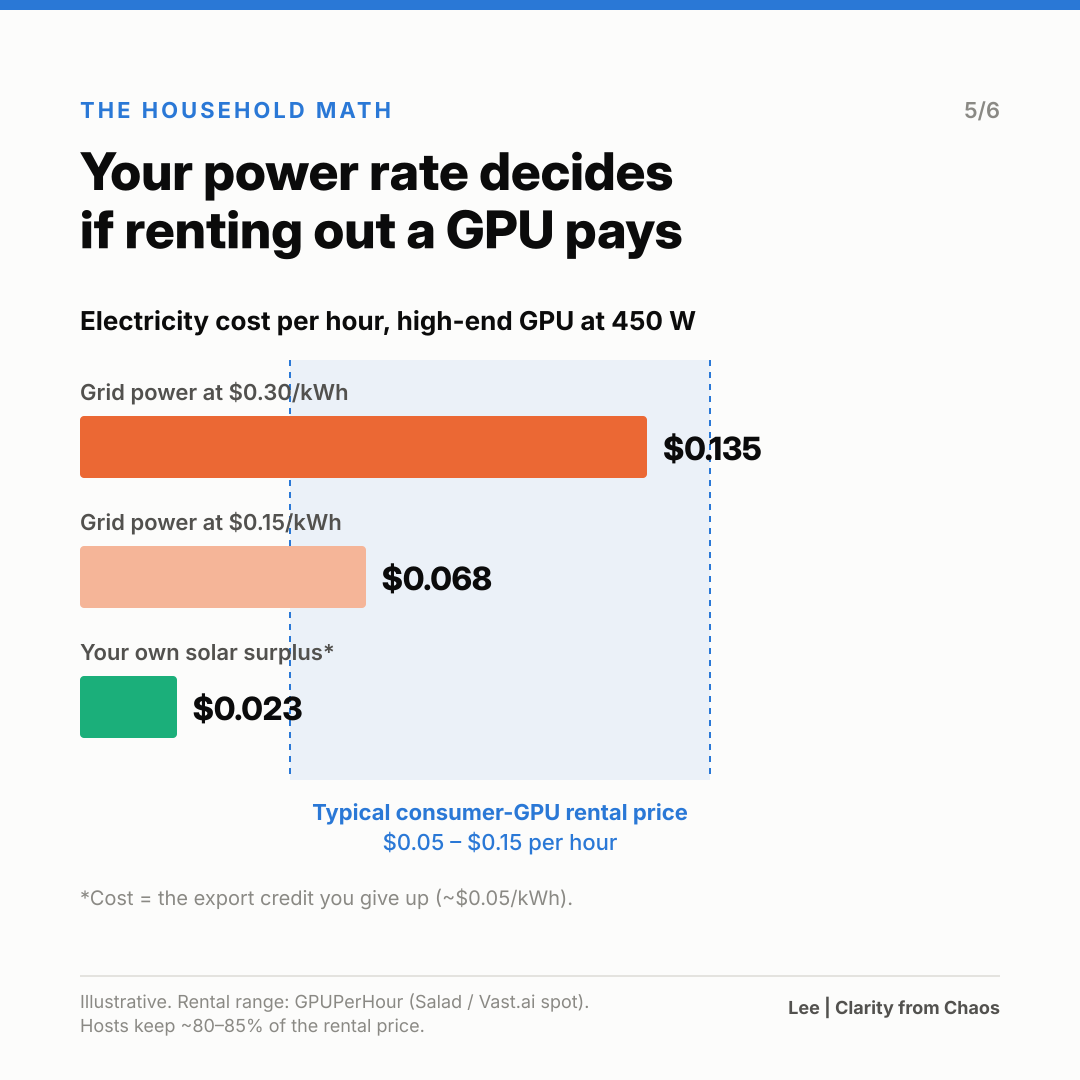
3. Solar sends power to the grid. A home GPU pulls power from it. This is the one that flips the whole picture. If thousands of homes start running GPUs around the clock, that isn't relief for the grid. It's more residential load, at the edge of the network, where nobody planned for it. You'd be recreating the data center problem in a distributed way.
Where democratization actually shows up
Here's the twist I didn't expect when I started digging into this.
The grid doesn't mainly need more compute. It needs flexibility. Studies have found that grid stress concentrates in a small number of peak hours each year. If big loads can ease off during those hours, utilities can connect a lot more of them without building as much new infrastructure. That's why Nvidia, EPRI, Emerald AI, Oracle and others have been running demonstrations where AI clusters cut power by around 25% during peak demand and ramp back up afterward. Duke Energy and Google have a flexibility pilot right here in North Carolina.
Now put the three stories together:
- Bitcoin miners got rich by being the most flexible load on the grid: soaking up cheap power and shutting off when it got expensive.
- Solar owners are being told their midday exports are worth only a few cents.
- AI data centers are being asked to flinch when the grid is stressed.
The household version of that playbook isn't "sell my GPU time 24/7." It's this:
Use cheap midday solar to run compute you'd otherwise export for pennies, and shut it off at peak.
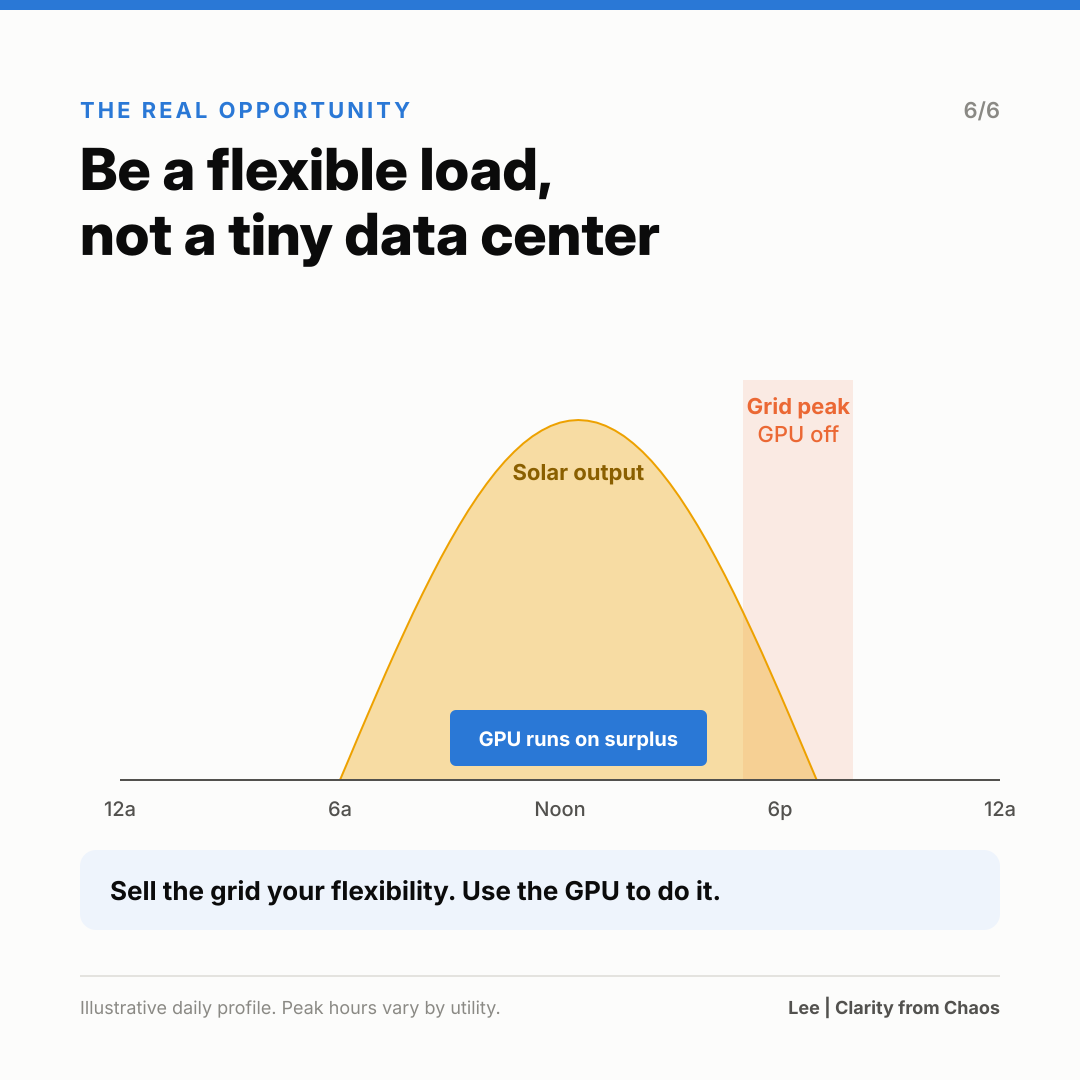
If your export credit is a few cents per kWh, running a GPU on that surplus power instead of selling it back changes the math. Your "electricity cost" for that compute is just the export credit you gave up. Pair it with a battery and you're also a candidate for demand-response programs. You're not a tiny data center. You're a tiny flexible power plant that happens to own a GPU.
That's a much more believable form of democratization. And it's the same thing the Bitcoin miners figured out: the scarce asset is controllable power, not chips.
What would have to happen for this to scale
I don't think the home-compute model becomes mainstream on its own. A few things would need to line up:
- Better verification. Bitcoin works because the work proves itself. AI inference doesn't, at least not cheaply. Until buyers can trust results from untrusted machines, home compute stays in the bargain bin.
- Grid-aware scheduling. Marketplaces would need to know when your solar is producing and when the grid is stressed, and route jobs accordingly. Some of this exists for big data centers. Almost none of it exists for homes.
- Utility tariffs that reward flexible home load. Right now, there's no "net compute" tariff. If utilities ever pay households to soak up surplus solar and back off at peak, the economics change fast.
- Security people actually trust. Sandboxing and open-source node software help, but most people still won't let strangers run code on the PC their kids use for homework.
And if it does scale, expect the net metering story to repeat itself: early sellers get good rates, then regulators and buyers adjust the price down to what the work is really worth.
The bottom line
We are seeing a democratization of compute, but at the edges: small models, batch jobs, hobbyists, and bargain hunters. It is not going to take pressure off the hyperscale data centers, and it isn't the solar story with a GPU swapped in.
The bigger shift is that power, and the ability to control when you use it, has become the most valuable thing in the AI economy. Bitcoin miners figured that out first. Data centers are learning it now. Homeowners with solar and batteries might be next.
The question isn't "can I rent out my GPU?" It's "can I sell the grid my flexibility, and use my GPU to do it?"
Sources
- S&P Global: Data center power demand to more than double by 2030
- EnkiAI: Data center grid constraint, canceled and delayed projects
- Introl: US grid capacity and PJM auction costs
- Utility Dive via Pulse: Winter storms and data center grid reliability
- KuCoin: Bitcoin miners pivot to AI infrastructure
- Business Today: Bitcoin miners and AI revenue share
- Unlock: Miner production costs vs. bitcoin price
- Cointelegraph: Why the miner pivot isn't plug-and-play
- Planning Report: The net metering retreat
- JouleIO: Net metering policy by state 2026
- NuWatt Energy: Net metering changes 2026
- Android Headlines: Startups want to rent your idle gaming PC
- GPUPerHour: Salad vs Vast.ai pricing
- Reuters via The Star: Stressed US grid forcing data centers to get more flexible
- Introl: Data centers as grid stabilizers (Phoenix demo, DCFlex)
Graphics marked illustrative use the stated assumptions, not measured results.
Comments
Comments are hosted by Disqus. Showing them loads Disqus, which sets cookies and may show ads (Disqus privacy policy).